

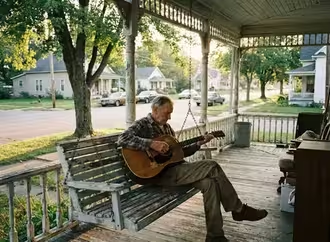
Every afternoon at 4:15, George Patterson carries his Martin D-28 to the same rocking chair on his Ravenswood porch and plays. Not for an audience. Not for practice. Just plays. I've been photographing him for three weeks now, trying to understand what he's doing out there.
The first time I noticed, it was a Tuesday in late November. Light already fading at quarter past four. I was walking back from Bill's place with a jar of kombucha when I heard it—acoustic guitar, tentative at first, then settling into something familiar. "Blackbird" by The Beatles, except George plays it slower than Paul McCartney ever did.
His porch faces River Road, set back maybe twenty feet from the sidewalk. The 1887 Folk Victorian cottage needs paint—George knows this, mentions it sometimes—but the porch is solid. Wide floorboards, original tongue-and-groove ceiling, a rocking chair positioned to catch the last western light through the bare sycamore branches.
The guitar is older than I am. George bought it used in 1982, taught himself to play from a Mel Bay book he still keeps in the front room. Forty-three years of the same six strings, replaced hundreds of times, wearing grooves into the same frets.
"You play every day?" I asked him the second week, camera around my neck, trying not to be intrusive.
"Since I retired," George said, not stopping the song. His fingers found the next chord without looking. "Taught high school English for thirty-seven years. Never had time for this. Now I do."
I'm not performing. I'm just playing. There's a difference. Performance asks something of people. Playing just... is.
He plays six songs. Always the same six, always in the same order. "Blackbird" first. Then "The Boxer" by Simon and Garfunkel. "Landslide" by Fleetwood Mac. "Tears in Heaven" by Eric Clapton. "Hallelujah"—the Leonard Cohen version, not the overdone covers. Finally, "Greensleeves," the old English folk song that's been around for four hundred years.
The sequence takes forty-three minutes. I timed it.
"Why those songs?" I asked on day nine, my camera quiet in my lap.
George stopped mid-chord, thought about it. "They're the ones I can play all the way through without messing up. Took me eight years to get 'The Boxer' right. Still working on the fingerpicking in 'Hallelujah.' Probably always will be."
Advertisement
He doesn't play them the same way twice. Some days "Landslide" is faster, almost cheerful. Other days it drags, every note weighted with something I can't name. "Tears in Heaven" makes him pause sometimes between verses, guitar resting on his knee, looking at the river through the trees.
People walk by. Tom running his evening route. Lucia heading home from the library. Carl shuffling down to Bill's porch for their sunset sitting ritual. Most don't acknowledge George. A few nod. Nobody stops to listen, exactly, but everybody hears.
"Used to think I'd play in coffee shops," George told me last Thursday, between "The Boxer" and "Landslide." "When I was younger. Thought that's what musicians did—performed. Found an audience."
He adjusted the guitar strap, flexed his fingers. Arthritis makes the barre chords harder now. Some mornings his hands don't cooperate until he's worked them for twenty minutes.
"Then I realized I don't want an audience," he continued. "I just want to play. Every day. Same time. Same songs. Like meditation, except with music."
The porch has become part of Front Street's rhythm. Rachel mentioned it once, said she sets her tea timer by George's guitar. "When I hear 'Blackbird' starting, I know I've got forty-three minutes before I need to think about dinner."
Last week, I brought my camera at 4:14. Sat on the sidewalk across the street, telephoto lens, waiting for the moment when George first touches the strings. There's this pause—maybe three seconds—where he just holds the guitar, remembering where his fingers go. Then muscle memory takes over.
The photos are terrible, technically. December light is unforgiving, and I refuse to use flash. But something about them feels true. An old man on an old porch with an old guitar, playing old songs because that's what Tuesday at 4:15 calls for.
"You ever think about learning new songs?" I asked yesterday.
George finished "Greensleeves," set the guitar in its stand. "These six took me years to get right. Why would I need more than six? The point isn't variety. The point is showing up."
He stood slowly, knees protesting the cold. Picked up the guitar stand and headed for his front door. The porch light came on automatically—same time every evening, photocell controlled.
"Same time tomorrow?" I asked.
"Same time every day," George said. "Until the weather turns too cold for the guitar. Then I'll play inside by the radiator until March."
This morning, I developed the photos in my makeshift darkroom—the pantry off my kitchen, blacked out with trash bags and hope. The best shot shows George's hands mid-chord change, fingers suspended between notes. His face is out of focus. The porch railing is sharp. The guitar's soundhole catches light from somewhere I can't identify.
It's not about being good, I realized, hanging the print to dry. It's about being consistent. About choosing six songs instead of six hundred. About 4:15 every afternoon, weather permitting, no audience required.
George taught high school English for thirty-seven years. Probably graded ten thousand essays about finding your voice, pursuing your passion, making your mark. Now he sits on a porch nobody asked him to sit on, playing songs everybody already knows, for nobody in particular.
That's the art, I think. Not the performance. The practice. The showing up. The daily decision that these six songs, this forty-three minutes, this cold porch in December matter enough to keep doing.
Tomorrow at 4:15, he'll carry the Martin to the rocking chair. Position it just so. Pause for three seconds. Then "Blackbird" will start again, slightly different than today, exactly the same as always.
I'll probably be there, camera ready, still trying to capture what makes a man play "Greensleeves" to an empty street. Still learning that some questions don't need answers. They just need witness.
12 COMMENTS




Rachel Kim
18 Dec 2024I set my tea timer by George's guitar. When I hear "Blackbird" starting, I know exactly what time it is. That's the kind of consistency this neighborhood needs.
REPLYMarcus Webb
18 Dec 2024As a music teacher, I love this. George understands something most students take years to learn: mastery isn't about quantity, it's about depth. Six songs played with intention beats sixty songs played carelessly.
REPLYBill Henderson
18 Dec 2024George and I don't talk much, but I hear him every evening from my porch. It's like the river—always there, always changing, always the same. That's ritual.
REPLYEmma Clarke
19 Dec 2024This is beautiful, Ben. I've walked past George's porch dozens of times and never stopped to really listen. Now I will. Thank you for helping me see what was always there.
REPLYAlex Turner
19 Dec 2024As someone who's been chasing an "audience" for years, this hits hard. Maybe I've been thinking about music all wrong. George gets it—it's not about performing, it's about showing up for the practice itself.
REPLY