
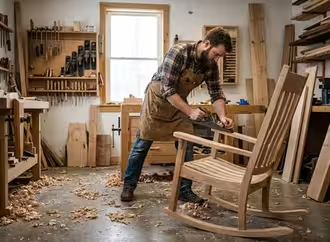
I started this rocking chair on February 3rd at 9:22 AM. I remember because I'd just bought the walnut boards the day before and couldn't wait to begin. It's December 22nd now. The chair still sits unfinished in my workshop, and I'm learning that patience isn't what I thought it was.
My workshop is the back room of my cottage on Second Street—used to be a storage room with peeling wallpaper and a single bare bulb. Now it's got my grandfather's workbench, windows I cleaned until the wavy glass actually let light through, and sawdust in every crack of the wide-plank floor no matter how many times I sweep.
The walnut came from a tree down in Athens County. The guy who milled it told me it had been growing since 1847. I paid too much for it because wood that old deserves respect, and also because I'm terrible at negotiating.
I had a plan. Sketches. Measurements. A timeline that seemed reasonable: six weeks, maybe eight if I ran into problems. I'd build a rocking chair the way my grandfather taught me—slow, careful, by hand. No shortcuts.
What I didn't account for was how walnut reveals itself.
Wood this old doesn't want to be rushed. It shows you where the knots are, where the grain changes direction, where your chisel needs to listen instead of force.
The first setback came in March. I'd shaped three spindles for the back when I noticed the grain running wrong on the fourth. Not wrong exactly—just different. I could have used it anyway. Nobody would notice. But I'd know, so I started over.
April brought the rockers themselves. I steam-bent the wood in a setup I built from Sarah's old wallpaper steamer and a length of PVC pipe. The first attempt cracked. The second warped unevenly. The third worked, but only barely, and I spent two weeks fine-tuning the curve with a spokeshave until my hands cramped every night.
Omar stopped by in May. He's across the street, helps everyone with tech problems, has the patience of someone who reboots routers for a living.
"Still working on that chair?" he asked, leaning against my doorframe.
"Still working," I confirmed, hand-sanding the seat panel for probably the fifteenth time.
"Looks good."
"It's not done."
"No," he agreed. "But it looks good anyway."
I've learned more from this chair being unfinished than I ever did from the furniture I rushed to complete. Patience is staying with something even when you're embarrassed it's taking so long.
Summer slowed everything down. Too hot to work in the back room during the day, so I shifted to early mornings—5:30 AM before the sun turned my workshop into an oven. Just me, the birds outside, and the steady rhythm of planing wood.
Advertisement
I made mistakes. Drilled a mortise hole a quarter-inch off in July. Had to plug it, re-drill, pray the joint would still hold. Gouged the armrest in August reaching for a chisel I'd left too close. Sanded it out, but you can still see where the grain changed if you know where to look.
Marcus from down the street plays piano. He stopped by in September, saw the chair taking shape.
"How long's this been going?" he asked.
"Seven months," I admitted.
He nodded, didn't laugh. "I've been working on the same Chopin prelude for two years. Some things take the time they take."
That helped, somehow. Knowing I wasn't the only one living with unfinished work.
October brought the joinery—the parts where everything has to fit perfectly or the whole chair falls apart. Mortise and tenon joints for the legs, through-wedged tenons for the arms, careful angles so the back reclines just right. I cut each joint three times: once in scrap wood to test, once in the actual piece, and once more when the first attempt didn't seat quite flush.
My Mennonite upbringing taught me that good work honors God. Not in a showy way—in the way joints fit tight, the way grain patterns align, the way something built right lasts beyond your lifetime. This chair won't be perfect, but it'll be honest. Every joint shows the work that went into it.
November brought assembly. The chair started looking like an actual chair instead of a collection of carefully shaped pieces. I could sit in it—carefully, with most of the weight on the workbench behind it—and feel how it would rock once I finished. That almost broke me, being so close but knowing I still had weeks of finish sanding, oil application, final fitting.
Megan, the vet, stopped by last week. She'd heard about the chair from someone who heard from someone else. Small town, small community—everyone knows what you're working on even when you work alone in a back room.
"Can I see it?" she asked.
I showed her. Explained the wood, the joinery, why it was taking so long. She ran her hand along the armrest where I'd gouged and sanded it smooth.
"It's beautiful," she said. "Is it for someone?"
"Just me. Just to see if I could."
"Can you?"
I looked at the chair—ten months of early mornings and evening hours and learning to live with imperfection. "I think so. Ask me in a month."
The chair's taught me that mastery isn't finishing quickly. It's staying present with each piece, each joint, each mistake, until the work is genuinely done.
It's December now. The chair needs another week, maybe two. Final sanding with progressively finer grits. Three coats of oil, rubbed in by hand, waiting days between each application. Installing the final wedges. Making sure every joint is tight, every surface smooth, every angle true.
I used to think patience meant enduring something unpleasant until it passed. This chair taught me different. Patience is staying curious about what the work needs next. It's trusting that good things take the time they take. It's learning that "still working on it" isn't failure—it's the practice itself.
This morning at 6:47 AM, I was in the workshop applying the second coat of oil. The walnut was glowing in the early light, grain patterns emerging like rivers in old maps. My hands knew exactly how to rub the oil in—small circles, light pressure, watching the wood drink it in.
The chair will be finished soon. Maybe by New Year's. Maybe not. Either way, I've already built what I needed to build: ten months of showing up, learning to work with wood instead of against it, making peace with the slow unfolding of something made by hand.
When it's done—truly done—I'll sit in it on my porch. I'll rock slowly, feel the curve I spent two weeks perfecting, notice every joint I cut and re-cut and cut again. And I'll probably start planning the next chair, because now I know what I didn't know in February: the point was never finishing quickly. The point was learning to stay.
7 COMMENTS


Elena Martinez
Dec 2024The studio time mentioned here resonates deeply. Some nights after my ER shift, I go straight to the pottery wheel. Clay doesn't judge tired hands.
REPLYNathan Cross
Dec 2024This patience described here—it's the same whether you're working wood or canvas. You can't rush good work. The material teaches you if you listen.
REPLYRachel Kim
Dec 2024I started taking Polaroids because I wanted to slow down. One shot, one chance. This article captures that same intentionality I seek in my own creative practice.
REPLYBen Okafor
Dec 2024Every time I document our artists at work, I'm struck by the focus and presence. It's meditation through making. This piece honors that beautifully.
REPLYEmma Clarke
Dec 2024I know at least three of the artists referenced here! Their dedication to their craft inspires me daily. This is what makes our valley special.
REPLY