


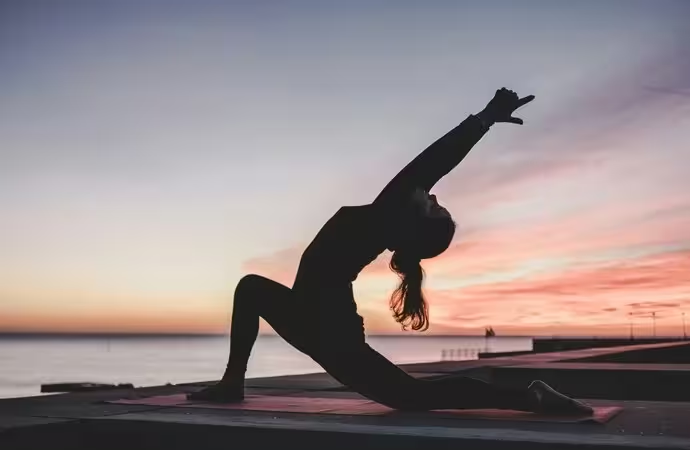
In our hyperconnected world of endless notifications and perpetual urgency, ancient breathing practices offer something radical: the ability to shift your nervous system in real-time, without apps, subscriptions, or special equipment.
It was 9:47 on a Wednesday morning when I noticed I'd been holding my breath at my desk. Again. Shoulders up by my ears, jaw clenched, scrolling through work emails like they were life-or-death urgent. My body was in full stress mode over a meeting request and a deadline that wasn't even until Friday.
I closed my laptop and sat back in the Windsor chair by my window—the one that catches morning light through the wavy Victorian glass. The Ohio River stretched out below, steady and unhurried. I put one hand on my chest, one on my belly, and just breathed. Three deep breaths. That's all. By the third exhale, something shifted. My shoulders dropped. My jaw unclenched. The emails were still there, but the urgency had deflated.
You're breathing right now—probably shallowly, probably unconsciously. Most of us take 20,000 breaths a day without noticing a single one. Yet how we breathe directly influences our stress levels, mental clarity, and emotional state. The yogis knew this thousands of years ago. Science is finally catching up.
Breathwork, or pranayama in Sanskrit, literally means "life force extension." It's not just deep breathing. It's conscious manipulation of breath patterns to create specific physiological and psychological effects. Some techniques energize. Others calm. Some balance. The power lies in having tools for different moments.
When breath wanders, mind is unsteady. When breath is still, mind is still. Control the breath and you gain control over the mind.
I started learning breathwork from Evie Stone last spring. She doesn't teach classes—Evie's not the studio type. But sometimes on Saturday mornings, a few of us gather on Bill's wraparound porch on Front Street, and she shares what she knows. No mats, no incense, just folding chairs and the sound of the river in the background.
"Breathwork isn't mystical," Evie said that first morning, sitting cross-legged in Bill's duct-taped rocker. "It's mechanical. Change how you breathe, you change your nervous system. That's just physiology." Then she taught us Box Breathing.
Box Breathing is stupidly simple: inhale for four counts, hold for four, exhale for four, hold for four. Repeat. Navy SEALs use this to stay calm under pressure. It works because equal-length breaths activate the parasympathetic nervous system—your body's natural relaxation response. I tried it that morning and felt my heart rate slow down by the third round.
Now when I'm stressed—before a difficult phone call, when I can't sleep, in the parking lot before grocery shopping during the crowded Saturday rush—I do four rounds of box breathing. Takes maybe ninety seconds. Works every time.
Advertisement

The second technique Evie taught us is Alternate Nostril Breathing. Sounds weird, works beautifully. Using your thumb and ring finger, you alternate closing each nostril while breathing—right nostril inhale, left nostril exhale, left nostril inhale, right nostril exhale. Repeat.
Rachel tried it that morning and immediately said, "This feels ridiculous." Evie laughed. "Most powerful practices do at first." By the end of five minutes, Rachel admitted she felt strangely balanced. That's what this practice does—it balances the left and right hemispheres of the brain, creating mental equilibrium. I use it now when I'm feeling scattered or can't make decisions.
Third is Three-Part Breath, where you consciously fill the belly, ribs, and chest in sequence, then reverse the exhale. This maximizes oxygen intake and teaches full diaphragmatic breathing—the way we're designed to breathe but mostly forgotten how. Tom the handyman said he'd been breathing wrong for forty-five years. Evie corrected him: "You've been breathing shallow. There's no wrong, just incomplete."
The beauty of breathwork is its accessibility. You can practice on the bus to Parkersburg, in the parking lot before a difficult meeting, or lying in bed when anxiety strikes at 3 AM. Your breath is always with you, always available, always free. No subscription, no special equipment, no teacher required—though learning from someone like Evie helps tremendously.
I practice now most mornings in my cottage's small parlor. The radiator clanks to life around 6:30, and I sit in the creaky rocking chair with my coffee cooling on the side table. Five minutes of three-part breathing while watching dawn light filter through the lace curtains. Some mornings it feels transformative. Other mornings my mind wanders and I forget what count I'm on. Both are fine. That's practice—showing up imperfectly, repeatedly.
Last Tuesday, Maya texted me at 2:47 PM: "Spiral mode. Help." I called her immediately. "Box breathing," I said. "Right now. Four counts. I'll do it with you." We sat on the phone in silence, breathing together for three minutes. When we finished, she said, "Okay. Better. Thank you." Then we hung up. That's how breathwork works in this community—practical, immediate, shared without fanfare.
Emma uses alternate nostril breathing before writing deadlines. Tom does box breathing in his truck before entering hardware stores (crowds make him tense). Sarah taught the three-part breath to a guest at the Marietta inn who was having a panic attack at midnight. It worked. The guest left her a five-star review mentioning "the innkeeper who taught me to breathe."
Start small. Pick one technique. Practice for just five minutes daily. Morning is ideal, before the day's momentum takes over. Sit comfortably, spine straight, eyes closed. Just breathe consciously. That's it. No perfection required. Evie always says: "You can't fail at breathing. You're already doing it. We're just doing it on purpose now."
The effects are cumulative. After a week, you'll notice moments of unexpected calm. After a month, difficult situations won't hijack your nervous system as easily. After three months, people will ask what's different about you. Your breath changed. Everything else followed.
This morning at 9:47, I got another stressful email. Same type that used to send me into shallow-breathing panic mode. This time I noticed my breath immediately—caught myself before the spiral started. Put my hand on my belly. Four counts in, four counts hold, four counts out, four counts hold. Three rounds. Then I replied to the email calmly, clearly, without the adrenaline-fueled urgency that used to drive my responses.
The email itself hadn't changed. The situation was still difficult. But I had changed how I met it. That's what breathwork offers—not escape from stress, but a different way to inhabit it. The ancient yogis understood this. Now, sitting in my Victorian cottage overlooking the Ohio River, practicing techniques that are thousands of years old, I understand it too.
Your breath is always with you. Start there. Everything else follows.
18 COMMENTS




Lisa Chen
18 Dec 2024Box breathing has become my go-to before important presentations. Cannot recommend this enough!
REPLYMark Davidson
18 Dec 2024Started with just 2 minutes a day. Three weeks in and my anxiety has noticeably decreased. Simple but profound.
REPLY