


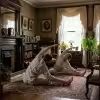
The first time my neighbor Emma saw me through the bay window, I was in yoga pants and one of my ex's old t-shirts, swaying barefoot on a worn Persian rug with my eyes closed and headphones in. She thought I was having some kind of crisis. Turns out, I was finding my way back to something I'd lost.
I danced in college. Nothing serious—just electives and the occasional student choreography showcase. I loved it, that feeling of moving without thinking, of letting music pull gestures out of my body. But after graduation, life happened. Job, relationship, bills, responsibilities. Dance became something I used to do, filed away with other youthful enthusiasms.
Twenty years disappeared like that. I worked administrative jobs, got married, got divorced, moved here to Ravenswood for a fresh start in one of those beautiful, slightly shabby Victorian cottages that needed someone who didn't mind crooked floors and temperamental radiators. The place had good bones and a bay window that caught morning light. That window changed everything.
One Tuesday morning, Bon Iver came on while I was washing dishes, and my hips just... moved. I set down the sponge and kept moving. Twenty minutes passed before I noticed I was crying and laughing at the same time.
After that, I started putting on music intentionally. Just for myself, in the living room. I'd push the coffee table against the wall, roll up the rug's edges, and move. Not choreography. Not yoga. Just whatever my body wanted to do. Sometimes it was gentle swaying. Sometimes wild, cathartic flailing. Sometimes I'd hold a lunge for three minutes, breathing, feeling the stretch and release.
It wasn't pretty. I wasn't flexible anymore. My knees cracked. I couldn't do half the things I remembered doing at twenty. But that didn't matter. For the first time in decades, I was back inside my body instead of just operating it like a vehicle to carry my head around.
Emma knocked on the door one Saturday morning. "I see you dancing," she said, direct as ever. "Can I join you sometime?" I almost said no—this was private, personal, messy. But something about her asking so simply made me say yes.
She came over that afternoon. We moved furniture to the edges, put on a playlist, and I just... moved. Emma watched for a minute, then started moving too. We didn't talk. We didn't perform for each other. We just inhabited the same space, each finding our own rhythm. Afterwards, sitting on the floor catching our breath, she said, "That was exactly what I needed. Can we do it again?"
Word travels in small communities. Elena, who teaches pottery at SILK Arts, asked if she could bring Maya from the Kundalini classes. Soon there were four or five of us, Tuesday and Thursday evenings, moving in my living room. We'd arrive in whatever comfortable clothes we owned—leggings, sweatpants, one woman always wore her husband's old overalls. Someone would queue up music. We'd move.
I started offering gentle suggestions. "Try moving from your hips." "What happens if you close your eyes?" "Can you make that gesture bigger? Smaller?" Not teaching, exactly. More like companioning. We'd laugh when someone knocked into furniture. We'd pause when the music moved us to stillness. Maya cried one night, then thanked us for holding space while she processed whatever needed processing.
Advertisement
My living room isn't a studio. There's a couch shoved against the wall, houseplants on the windowsill, my cat judging us from the armchair. But that's the beauty of it—movement practice doesn't need special spaces. It needs permission and a little room.
We're not a class. I don't call myself a teacher. We're just a handful of people who gather twice a week to remember we have bodies, to move them with intention and joy, to be seen and held in our awkward, beautiful attempts at presence.
Sometimes only two people show up. Sometimes seven, and we're bumping into each other, laughing. I've invested in a Bluetooth speaker that doesn't cut out mid-song. Someone brought an essential oil diffuser. Elena contributed a thick yoga mat for anyone who wants to work on the floor. These small additions feel like collective ownership of the practice.
What surprises me is how little instruction anyone needs. I might offer a prompt—"Today, move like water" or "Find three shapes your spine can make"—but mostly people discover their own movement when given permission and presence. That's the practice: showing up, being witnessed, letting the body speak.
Someone asked recently if I'd ever teach "real" classes, maybe rent studio space. The question felt odd. This is real. Movement practice happening in a living room with furniture pushed aside and a cat supervising from the armchair. Nothing about it is less legitimate because it's humble, domestic, unprofessional.
If anything, the informality is the point. We're not performing. We're not achieving. We're just moving together, rediscovering what our bodies remember about joy, expression, and being alive. That happens just fine—maybe better—between a coffee table and a bay window.
8 COMMENTS




Emma
16 Dec 2024Still one of my favorite parts of the week. Thank you for letting me stumble around your living room, Annie.
REPLYRachel K
16 Dec 2024I love that this happens in a living room, not a studio. Makes it feel like something I could actually do, not another thing I'd need to be "good at."
REPLYMaya
16 Dec 2024That night I cried was the night I needed to cry. Thank you all for just... being there. No fixing, no explaining. Just presence.
REPLYEvie Stone
17 Dec 2024Movement as meditation, dance as prayer. Annie, you've created something beautiful here. This is yoga in its truest form.
REPLYJacob Torres
17 Dec 2024I tried one session. Felt ridiculous. Also felt free. Might come back.
REPLY