



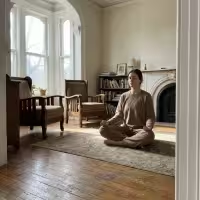
I'm not good at sitting still. Never have been. I'm the person who fidgets through meetings, scrolls their phone while watching TV, eats lunch while working. The idea of deliberately doing nothing sounded like torture.
Then I read something about meditation—I don't even remember where, probably some article that showed up in my feed—and the description stuck with me: "Learning to be with yourself without distraction." I realized I never do that. I'm always doing, always consuming, always moving to the next thing.
So I decided to try. Not because I wanted to be enlightened or spiritual. Just because I was curious if I actually could sit still for twenty minutes without my phone, without a book, without anything.
The first morning was absurd. I sat on an old cushion in the corner of my Ravenswood parlor—the one spot where morning light comes in nice—set a timer on my phone, and... sat. Within thirty seconds my mind was racing. I thought about work. Then breakfast. Then that email I forgot to send. Then the weird noise my car made yesterday. Then I wondered if this was working. Then I checked how much time had passed. Two minutes.
Meditation isn't about emptying your mind. It's about noticing that your mind is full and sitting with that anyway.
I kept going. Mostly out of stubbornness. Every morning at 5:30 AM, before my brain fully wakes up and starts making excuses, I sit on that cushion. Some mornings I make it the full twenty minutes. Some mornings I give up at fifteen. Some mornings my mind is so loud I can't believe people do this voluntarily.
But something's shifting. Not dramatically. Not like the before-and-after photos you see online. It's subtler than that. I'm noticing things I usually miss—the way the radiator sounds before it starts heating, the pattern of bird sounds outside, the exact moment when the room transitions from dark to dawn.
And I'm noticing my thoughts differently. Before, I'd have a anxious thought and just... believe it. Get swept into it. Now I can sometimes catch it: "Oh, there's that story again about how I'm going to fail at everything." The thought still happens. But there's this tiny gap now where I see it as a thought, not as truth.
I'm not doing it right, probably. I've never taken a meditation class. I don't know the proper techniques. I just sit there, notice when my mind wanders (constantly), and bring my attention back to my breath or the sounds in the room or the feeling of sitting. That's it. That's the whole practice.
Rachel, who rents a room two houses down, asked me about it when she saw me sitting by the window one morning. "Are you meditating?" I said I was trying. She said she'd tried too but couldn't quiet her mind. I told her my mind isn't quiet either. It never shuts up. But I'm learning that's not the point.
The point—as far as I understand it, which isn't far—is showing up. Sitting still even when everything in you wants to jump up and do something productive. Letting thoughts come and go without following them down every rabbit hole. Being okay with twenty minutes of nothing happening.
It's the opposite of everything our culture teaches. No achievement. No optimization. No measurable progress. Just sitting in a corner of a 130-year-old house, watching dust move through morning light, being alive and still for twenty minutes before the day demands everything else.
I've been doing this for four months now. Some days I love it. Some days I resent the timer and count down every minute. But I keep showing up to that corner, that cushion, that practice of deliberate nothingness.
Advertisement
Because in a life that's always moving, always producing, always on—twenty minutes of stillness feels quietly rebellious. And necessary. And harder than any marathon I've ever considered running.
16 COMMENTS





Emma Chen
13 Dec 2024"Twenty minutes of deliberate nothingness" is such a perfect way to describe meditation. I've been trying for weeks and it's exactly as hard as you describe.
REPLYJesse Thompson
13 Dec 2024Been meditating for years and my mind still isn't quiet. The gap you describe—seeing thoughts as thoughts, not truth—that's the whole thing right there.
REPLY