



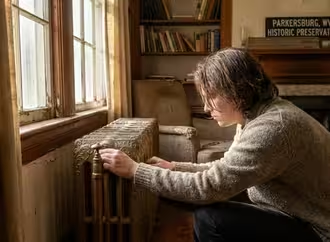
There are people in every community who know things—not from books or classes, but from decades of paying attention. Michael Foster is one of those people. And he knows radiators.
Patty's Story: The Closet That Wouldn't Close
Patricia "Patty" Webb, 40, part-time bookkeeper, Marietta
It was 8:47 on a Thursday morning when I finally admitted defeat. I'd been trying to organize the upstairs closet in our 1888 Gothic Revival cottage for three days. Victorian closets are tiny—this one was maybe three feet wide—and I'd bought every organizing system Target sold. Hanging shelves, door racks, slim-profile hangers, vacuum bags for out-of-season clothes.
Nothing fit. The door wouldn't close anymore. I was sitting on the hallway floor surrounded by rejected organizing products when I heard Marcus downstairs saying hello to someone. Then Michael Foster's voice: "Heard you've been wrestling with that closet."
Michael lives two doors down. He's 60, semi-retired from contracting, wears the same flannel shirt in three different colors, and somehow knows when people are struggling with their houses. I'd never spoken to him about the closet. But there he was, toolbox in hand, waiting for permission to look.
"These closets weren't built for what we try to put in them," he said, standing in the doorway. He pulled a small flashlight from his pocket and examined the interior. "See this?" He pointed to slight wear marks on the original plaster walls. "Someone hung clothes on wall hooks for ninety years. That's what these spaces were designed for."
He sat down on the floor beside me—this 60-year-old contractor in work boots, just sitting on my hallway floor like it was completely normal. "You can't organize a Victorian closet with modern systems. The proportions are wrong. The depth is wrong. The whole logic is different."
These houses were built before people owned this much stuff. You're not failing at organizing. You're trying to make a system work that was never designed for current life.
We spent the next hour emptying that closet completely. Michael showed me where the original hooks had been mounted—there were still small holes in the plaster. He explained that people in the 1880s owned maybe three outfits, hung them on hooks, and stored off-season items in trunks. The closet wasn't a failure of design. I was just asking it to do a job it was never meant for.
"So what do I do?" I asked, looking at the pile of clothes and rejected organizing systems.
"You make choices," he said. "Keep what you actually wear. Store the rest somewhere else. Or you accept that you'll need modern furniture—a wardrobe or dresser—and use the closet for what it's good at: a few hanging items and maybe shoes."
We installed four simple brass hooks at the original heights—Michael had extras in his truck. I hung my four favorite dresses and my winter coat. Put shoes on the floor. The rest went in a dresser we moved from the spare room. The closet door closed perfectly. The hallway felt calmer. I'd spent $87 on organizing systems that didn't work and resented my house for days. Michael spent an hour teaching me to work with it instead of against it, and charged me nothing.
"That's just neighborly," he said when I tried to pay him. "Besides, I like these old houses. Someone should understand them."
Rick's Story: The Carriage House Dream
Richard "Rick" Brooks, 33, brewery owner, Ravenswood
I bought our cottage on Front Street specifically because of the carriage house out back. The main house is an 1893 Carpenter Gothic, beautiful but small. The carriage house was 320 square feet of potential. I had plans: home brewery setup, tasting room for friends, maybe eventually a small commercial operation.
I'd been working on the conversion for six weeks. Cleaned out decades of accumulated stuff, repaired the wide-plank floor, installed LED work lights, ran new electrical. I was planning the brewing equipment layout when Michael showed up one Saturday afternoon with two bottles of homebrew—his own recipe, apparently—and asked if he could look around.
"Hannah mentioned your plans," he said. Hannah's my wife; she teaches at the elementary school with Michael's daughter. Small town connections.
We drank his homebrew—which was excellent, a Belgian-style wit—and he walked the space slowly. Looked at the ceiling joists, the windows, the foundation. Didn't say much. Then: "You've got a drainage problem. See how the floor slopes toward that corner? Water's been coming in there for years."
I hadn't noticed. The floor was dry when I worked on it. But Michael pointed to subtle staining on the baseboard, slight discoloration in the wood grain. "Spring thaw and heavy rains, you'll get water. Might be fine most of the year, but you put brewing equipment in here, you need to address it first. Water and wood floors and heavy equipment—that's a recipe for rot."
He could have charged me hundreds to fix it. Instead, he spent the next three Saturdays teaching me how. We dug a French drain along the exterior foundation. Re-graded the soil. Sealed the foundation interior. He showed me how to read the building—where water wanted to go, how these old structures settled, what mattered and what was just cosmetic age.
"You've got a good eye for design," Michael said while we mixed concrete for the drain. "But these old buildings need you to think in decades, not weeks. A French drain now saves you thousands in floor repairs five years out."
Old buildings teach patience if you let them. They've been standing for a century. They're not in a hurry. You shouldn't be either.
The brewery setup is taking longer now. But it's being done right. Last weekend, Michael brought over his notes on carriage house ventilation—apparently he'd converted one in Parkersburg fifteen years ago and still had the sketches. Just handed them to me, said they might be useful, refused payment again.
"Pay it forward," he said. "Someone taught me this stuff thirty years ago. I'm just passing it along."
Advertisement
Michael's Story: The Radiator on Walnut Street
Patty Webb, recording Michael's explanation over coffee, December 2024
I asked Michael how he knew so much about old houses. We were drinking coffee at Maya's kitchen table—Saturday morning, the usual gathering—and I'd been telling everyone about the closet revelation. Michael was quiet most of the conversation, but when I asked directly, he set down his mug and thought for a moment.
"I grew up in one of these houses," he said. "1887 Queen Anne over on Walnut Street in Ravenswood, where Ruth and Howard live now. My grandfather bought it in 1952 for $3,000. No one wanted these old places back then. Too big, too expensive to heat, too much maintenance."
He described learning to fix things because there was no money to hire anyone. How his grandfather taught him to listen to radiators—the difference between normal thermal expansion sounds and the clanking that meant a pitch problem or water hammer. How to bleed air from the system each fall. How to replace packing nuts on old valves without breaking the century-old fittings.
"By the time I was sixteen, I could diagnose radiator problems by sound," Michael said. "Drove my mother crazy—I'd be in my bedroom and yell down 'The parlor radiator needs bleeding' or 'Someone left the basement valve half-open again.'"
He started doing contracting work at nineteen. Learned framing, electrical, plumbing through apprenticeship. But the old houses kept calling him back. "Modern construction is fine," he said. "But these Victorian cottages—they've got personality. They're built from old-growth lumber, real plaster, cast iron. They were meant to last. Seems wrong to let them die from misunderstanding."
Tom Richardson, who was also at Maya's that morning, asked the question I was thinking: "Why don't you charge for this knowledge? You could make good money consulting."
Michael shrugged. "I do charge for actual work. But helping someone understand their house? That's different. These cottages hold communities together. People move into them thinking they're buying a cute old house, and they get overwhelmed when it doesn't behave like a modern building. They sell, move on, and the house sits empty until someone buys it for rental income. That's how neighborhoods die."
If I can spend an hour teaching someone to love their hundred-year-old house instead of fight it, that's an hour invested in this community still being here in another hundred years.
He's helped seventeen households in the SILK communities over the past two years. Radiator education, foundation assessments, plaster repair tutorials, window restoration guidance. He keeps a notebook of each house he visits—original details, quirks, what's been modified, what needs watching. He showed it to me once: careful sketches, measurements, notes in neat handwriting about pitch angles and vent sizes and joist spacing.
"These houses are the history of the Ohio River Valley," he said. "Built when this was a booming waterway, when these towns mattered. They deserve better than being covered in vinyl siding and filled with forced-air systems that ignore their original logic."
The Transmission
Patty Webb
Three weeks after Michael helped me with the closet, I heard Nathan from Second Street talking about his Victorian wardrobe restoration project. He was struggling with a stuck drawer, ready to force it or give up. I remembered Michael's words about working with old houses instead of against them.
"Hold on," I said. "Let me show you something."
I didn't know much about furniture. But I knew about patience. About looking at how something was designed before trying to fix it. About asking what the original builder intended instead of imposing modern expectations. I sat on Nathan's workshop floor—just like Michael had sat on my hallway floor—and we examined that drawer together.
Turns out it was swollen from humidity. It needed to dry out, not be forced. We took it out completely, let it sit for a week, then it slid back perfectly. Nathan was amazed. I told him about Michael and the closet.
"That's exactly what Michael would say," Nathan laughed. "He helped me with dovetail joints last year. Spent two hours teaching me to read the wood grain."
That's when I realized: Michael isn't just fixing houses. He's teaching a way of thinking. And it spreads. Rick now helps new homeowners with carriage house assessments. I've talked three neighbors through closet reorganizations using Michael's logic. Tom Richardson has started a lending library of old house repair books, inspired by Michael's notebook system.
The knowledge doesn't die. It transmits. One flashlight examination, one Saturday afternoon, one honest conversation at a time.
Michael Foster, the radiator whisperer, the contractor who won't charge for neighborly help, is building something more permanent than any house foundation. He's building a community that knows how to care for the structures that hold it together. And he's doing it the old way: by showing up, paying attention, and trusting that good work creates more good work.
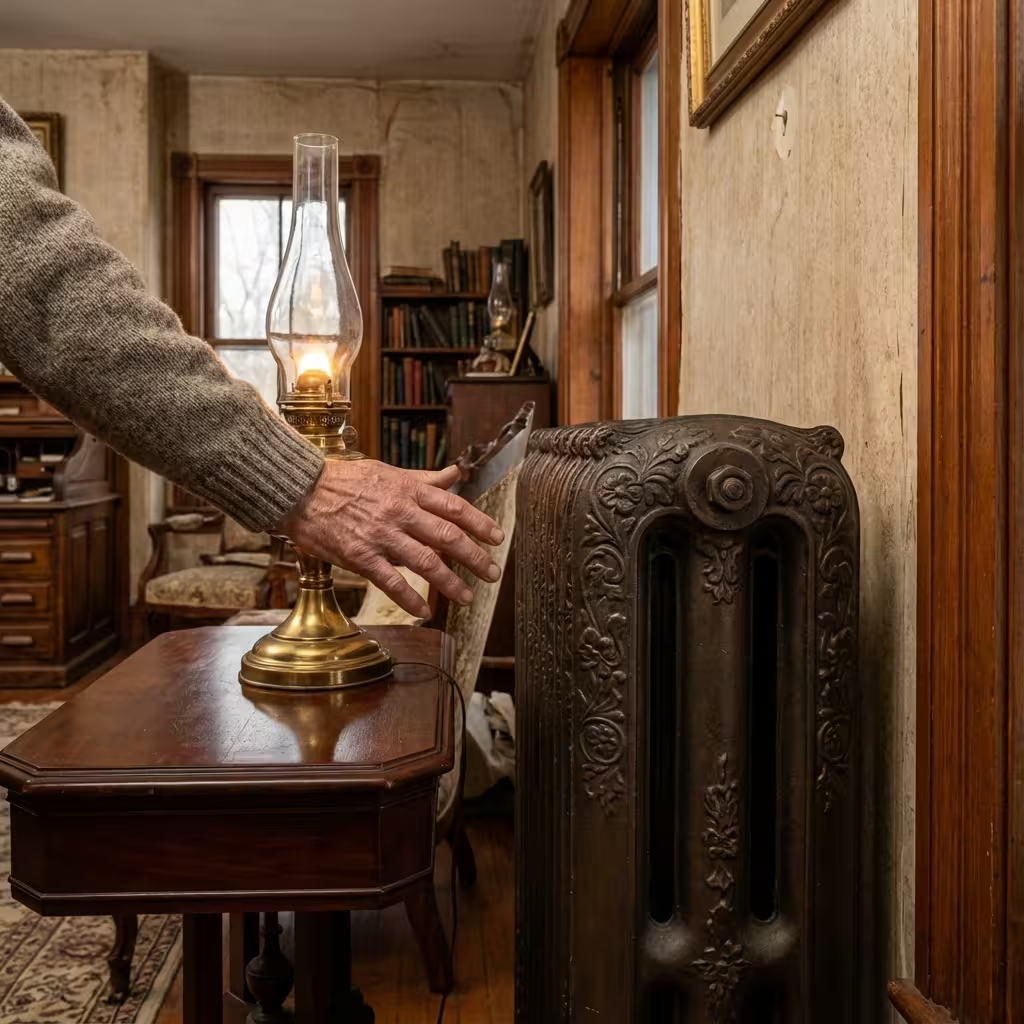
Last Tuesday at 9:15 AM, I saw him walking toward Jesse's cottage with his flashlight and notebook. Jesse's been complaining about cold spots in his bedroom. Michael will sit on the floor, examine the radiator, explain the physics of steam heat, and refuse payment. Jesse will learn. And someday, Jesse will sit on someone else's floor and pass it along.
That's how old houses survive. Not through restoration grants or historic preservation committees—though those help. They survive through people like Michael Foster, who understand that a house is more than walls and plumbing. It's a teaching tool, a community anchor, a 130-year conversation between builders and occupants about what it means to make shelter that lasts.
And if you're lucky enough to live in one of these cottages, and patient enough to listen, the house will teach you too. Michael just helps with the translation.
12 COMMENTS



Tom Richardson
21 Dec 2024Michael taught me half of what I know about old house repair. The other half I learned from breaking things and having to call him to fix them. This article captures exactly who he is—sitting on floors, refusing payment, teaching instead of just doing.
REPLYHannah Brooks
21 Dec 2024Rick has learned so much from Michael. Last weekend he helped Nathan with a foundation question, using exactly Michael's methods—look first, listen, understand before acting. That transmission Patty talks about is real.
REPLYJesse Martinez
21 Dec 2024Michael showed up at my door Tuesday like Patty said. Spent an hour teaching me about steam heat balance. Didn't charge a dime. When I tried to pay him, he just said "teach someone else someday." So I will.
REPLYSam Rivera
21 Dec 2024This is what community looks like. Not formal programs or committees, but someone who knows things taking time to teach. Michael helped me understand my radiator system last winter. Changed everything.
REPLYRuth Goldstein
21 Dec 2024We bought Michael's childhood home on Walnut Street fifteen years ago. He still stops by occasionally to check on "his radiators." Never intrusive, just genuinely cares about the house. It's beautiful to see that kind of long-term relationship with a building.
REPLY