



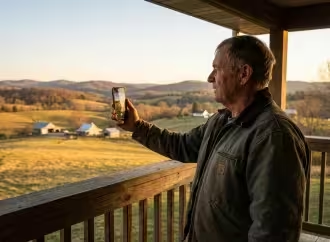
Last Tuesday, Emma stood on the porch holding her phone at arm's length like a divining rod, trying to get enough signal to download a meditation app someone recommended. "This is extremely unzen," she announced to no one in particular. Welcome to wellness technology in the Mid-Ohio Valley.
I moved here from San Francisco eight months ago. In the city, my phone was an extension of my hand—5G everywhere, apps for everything, seamless connectivity I took completely for granted. Here in Ravenswood? I've learned to plan around signal the way farmers plan around weather. Some apps work. Most don't. All require a different relationship to technology than I'd ever considered.
The question isn't "what are the best wellness apps"—every lifestyle blog answers that. The question is: how does a small intentional community actually use technology when cell service is a suggestion rather than a guarantee?
Emma's Downloaded Meditation Library (Eventually)
Emma teaches at the local elementary school and has exactly 20 minutes for morning meditation before chaos begins. After the porch signal incident, she discovered Insight Timer has downloadable meditations. "Game changer," she says. "I download five or six on Sunday when I drive to Parkersburg for groceries. Better signal there."
She's particular about which ones work. "I need a teacher's voice that doesn't make me want to throw my phone. Calm, not condescending. Grounded, not floaty." She's found three instructors she loves and downloads their new content weekly. The app's social features? Useless here. The timer? Works offline. Perfect.
"The irony is that spotty service makes me more intentional," she adds. "I can't mindlessly browse meditation options. I have to choose deliberately when I have signal, then trust those choices later. It's actually very... mindful."
The best thing about rural internet is it forces you to think before you download. I can't impulse-install every app that promises transformation. I have to actually want it.
Tom's Breathing App Situation
Tom is a carpenter who discovered breathwork helps with anxiety. He tried several apps—Breathwrk, Othership, the fancy one that costs $70 a year. "They're all beautiful," he says. "Gorgeous interfaces. Streaming audio. Completely useless when my phone has no signal, which is most of the time I'm working."
His solution: a free app called iBreathe that's basically a visual metronome. No streaming. No audio. Just a simple animation showing when to inhale and exhale. "It looks like it was designed in 2010," he admits. "But it works anywhere. Construction site, woods, middle of nowhere. No connection required."
He's taught half the community the 4-7-8 breathing pattern using it. The app is ugly, functional, and exactly what's needed. "San Francisco would never," he jokes.
What Actually Works Here
Our community has developed unofficial criteria for useful wellness apps:
1. Offline functionality is mandatory. If it requires constant connection, it's useless. We've learned to check reviews specifically for offline modes.
2. Downloads must be lightweight. When you're downloading over patchy signal, a 500MB app update is half a day's project. We gravitate toward simple, lean apps.
3. Battery usage matters. When your phone is your only connection and charging isn't always convenient, apps that drain batteries get deleted fast. Sarah gave up on a beautiful sleep tracking app because it killed her phone by morning.
4. One-time purchases beat subscriptions. Not a signal issue—just values. We're skeptical of apps that want $15/month for features we could access free five years ago. Jacob uses a $4 meditation app he bought once in 2019. Still works perfectly.
The Analog Backslide
Here's what's happened to several of us: we came seeking mindful technology, discovered it barely works here, and accidentally returned to analog practices.
Maya started with journaling apps. Signal issues made syncing unpredictable. She switched to a physical notebook. "Now I journal by the river where there's definitely no signal," she says. "Turns out I prefer it. The phone was solving a problem I didn't actually have."
Bill tried yoga apps. Videos buffered endlessly. He ended up driving to SILK Yoga's Wednesday class in Marietta instead. "Real humans teaching real poses," he says. "Revolutionary concept."
I attempted a meditation app habit. Gave up. Started sitting on the porch for 15 minutes every morning with coffee, no phone, just watching the Ohio River. It's been more consistent than any app streak I ever maintained in San Francisco.
Maybe the best wellness technology is the kind that fails enough that you're forced to do the practice without it.
What We Share
We have a running list on the kitchen whiteboard: "Apps That Actually Work Here." It's community knowledge, updated constantly.
Current favorites include Emma's meditation downloads, Tom's breathing metronome, a simple walking tracker that works offline (Jacob uses it for forest hikes), and—this one surprised me—a moon phase app. No signal required. Sarah uses it to plan garden planting. Bill uses it because he likes knowing.
We've also learned to share downloads. When someone drives to Parkersburg or Charleston, they'll text: "Good signal, need anything?" People request specific podcast episodes, meditation downloads, app updates. It's a gift economy of bandwidth.
The Real Lesson
Here's what eight months in low-signal Appalachia has taught me about wellness apps: intention isn't something you practice—it's something geography can force on you.
In San Francisco, I had 47 wellness apps installed. I used maybe three regularly. The others were aspirational clutter, downloaded in moments of optimism, abandoned by morning. Here, I have six apps total. I use five of them daily. The difference? I can't afford to install things I won't use. Limited bandwidth creates clarity.
Emma says it best: "The city lets you pretend you'll become a different person if you download the right app. Here, you have to actually decide what matters, download it when you can, and commit to using it. The phone doesn't solve the problem. You do."
Last week, Bill's meditation app stopped working—some login issue requiring connectivity he didn't have. He sat on the porch anyway, timing 20 minutes on his watch, no guidance, just breathing. Afterward he shrugged. "Turns out I don't need the app. I already know how to sit still."
Maybe that's the whole point. The apps are training wheels. Eventually you're supposed to ride without them. Rural Appalachia just makes that lesson arrive faster—whether you're ready or not.
17 COMMENTS



Rachel from Marietta
17 Dec 2024THE WHITEBOARD LIST! We do the same thing at our house. "Apps that work without signal" is basically survival knowledge here. Also dying at "This is extremely unzen."
REPLYJames K.
17 Dec 2024Former tech worker here. Moved from Seattle to rural Virginia. This is TOO REAL. I had a full breakdown trying to stream a yoga class. Now I just... do yoga? Without the app? Wild concept.
REPLYKevin Lee
17 Dec 2024The meditation app recommendation is solid—I use Insight Timer with my students for mindfulness exercises.
REPLYOmar Hassan
17 Dec 2024Tech for wellness works when it gets you offline faster. Good apps are training wheels, not permanent solutions.
REPLYMarcus Webb
18 Dec 2024I love that these recommendations are about intentionality, not just consumption. Quality over quantity.
REPLY