


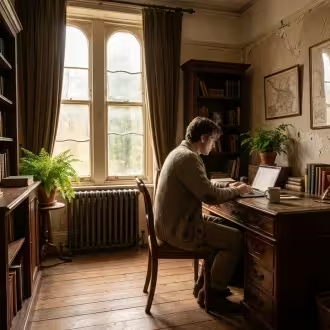
My "office" is a converted parlor in an 1890s cottage with wavy glass windows, crooked floors, and WiFi that drops every time a truck drives past. I work in software engineering. This shouldn't work. Somehow, it does.
I moved to Ravenswood eighteen months ago for a remote position with a tech company in Austin. They didn't care where I lived as long as I showed up on Zoom and shipped code. I picked the Mid-Ohio Valley because rent was reasonable and I was tired of city living. I found SILK Homes through someone's blog post about intentional communities.
When I arrived at the Victorian cottage that would become home, Jake walked me through the layout. "This was the formal parlor," he said, gesturing to a room with tall ceilings, original woodwork, and windows that had seen better decades. "Most people use it as a living room, but you mentioned remote work. Could be your office if you want."
I looked at the sloping floors, the radiator that clanked dramatically, the light fixtures hanging at slightly wrong angles. Then I looked at the natural light pouring through those wavy old windows. "Yeah," I said. "This'll work."
Nothing says "professional software engineer" like apologizing to your team because the WiFi router is having feelings again.
The tech setup took creativity. The cottage was built before electricity, let alone ethernet. We ran cable along baseboards. I mounted my router on an antique shelf that Emma (my housemate and high school history teacher) said was "probably valuable." I bought a cellular backup hotspot for when the internet inevitably failed. My desk is a farmhouse table from someone's attic. My office chair sits slightly askew because the floor isn't level.
During video calls, colleagues comment on my background. "Is that real woodwork?" "Are those original windows?" I explain that yes, I work from a 130-year-old house, and yes, that creaking sound is just the building settling, not a structural emergency. My manager once asked if I was working from a museum.
The irony isn't lost on me—I write code for cloud infrastructure while sitting in a house built when "the cloud" meant weather. But there's something grounding about it. When I'm debugging a production issue at 2 AM, the old house feels solid. Patient. It's seen harder problems than crashed servers.
Accidental Coworking
I thought remote work meant working alone. Turns out, living with Emma and being part of the broader SILK community created something better than any coworking space.
Emma teaches remotely some days. We started coordinating schedules—she'd use the kitchen table for virtual classes while I took the parlor for meetings. Between calls, we'd debrief over coffee. She'd vent about school district bureaucracy. I'd complain about deployment pipelines. Different industries, same frustrations with institutional dysfunction.
Wednesday afternoons, Maya (occupational therapist, lives three houses down) started bringing her laptop over. "My apartment is too quiet," she said. "Mind if I work here sometimes?" Soon it became routine—Maya at the dining table doing documentation, me in the parlor writing code, Emma grading papers in the kitchen. We'd work in companionable silence, occasionally calling out questions or observations.
"This is what coworking should be," Maya said once. "Not a WeWork with ping pong tables. Just people doing their work in the same space, available but not demanding."
The best collaboration happens when you're not trying to collaborate—just working alongside people you trust, available for the moments that matter.
Bill (retired engineer, volunteers at the community garden) drops by sometimes to "fix things." Last month he rewired an outlet so I could add another monitor. He stayed for an hour, asking questions about my work. I tried explaining Kubernetes. He compared it to plumbing systems. Somehow, his analogy was perfect. I used it in a presentation the next week.
The Old House Teaches Patience
Working in a Victorian cottage has taught me things no tech job could. When the WiFi drops mid-meeting, I've learned to laugh instead of panic. When the radiator starts its dramatic clanking, I mute my mic and wait. When the power flickers during a thunderstorm, I've got my cellular backup and a UPS for the router.
The house doesn't care about my deadlines. It operates on its own timeline—settling, creaking, demanding attention when it needs repairs. There's something humbling about that. In tech, we obsess over milliseconds of latency. The house reminds me that sometimes things just take the time they take.
Emma pointed this out once: "You've gotten calmer since you moved in. Less frantic about work stuff."
She's right. The house has a way of putting things in perspective. It's survived over a century—economic depressions, world wars, countless tenants with their own dramas. My production issues are not, in the grand scheme, that serious.
Community Tech Support
Being the "tech person" in a small community has unexpected benefits. I've helped Emma troubleshoot her school's terrible video conferencing setup. Maya calls when her telehealth platform acts weird. Bill wanted to learn about "this cloud thing everyone talks about," so I drew diagrams on the back of seed catalogs.
In return, Emma proofreads my documentation (turns out teachers are excellent editors). Maya has taught me about ergonomics and preventing repetitive strain injuries (crucial for developers). Bill shares garden produce and occasionally fixes things I didn't know were broken.
It's not a formal exchange—just people helping each other because we're neighbors and that's what you do. But it's more valuable than any professional networking event I've attended.
The Balance
I still work for a tech company. I still ship code, attend meetings, deal with on-call rotations. But I do it from a converted parlor in a creaky old house, surrounded by people living their own versions of intentional work-life integration.
Some days, Maya and I take afternoon "walking meetings"—her doing therapy notes via voice dictation, me thinking through architecture decisions out loud. We walk the neighborhood, past other Victorian cottages, down to the river. It's not "productive" in any measurable way. It's also essential.
My colleagues in Austin work from modern apartments with perfect internet and climate control. They're probably more efficient. But when they complain about isolation and burnout, I think about Emma making coffee, Maya showing up with her laptop, Bill teaching me about electrical systems, the radiator's comforting clank, and the afternoon light through those wavy old windows.
I'm not more productive here. But I'm more human. And that, it turns out, makes me better at my job—more creative, more patient, more connected to why the work matters.
The house has taught me that you don't need a coworking space with amenities and branding. You just need a place where work and life aren't at war, where community happens organically, and where crooked floors and spotty WiFi are features, not bugs.
15 COMMENTS


Emma Hartley
18 Dec 2024Sam forgot to mention that the WiFi router incident involved me accidentally unplugging it to charge my laptop during his sprint planning meeting. Still apologizing for that one.
REPLYMaya Chen
18 Dec 2024The walking meetings have become my favorite part of the week. Nothing like processing therapy notes while watching the Ohio River and listening to Sam debate microservices architecture with himself.
REPLYRachel K
18 Dec 2024As a remote worker in a generic apartment complex, this makes me deeply jealous. The idea of working alongside actual community instead of isolation is exactly what I'm missing.
REPLYOmar Hassan
18 Dec 2024This perfectly captures what I love about our tech repair café model—people helping each other because we're neighbors. No transaction necessary. Just community.
REPLYJennifer Walsh
18 Dec 2024As someone who teaches from a Victorian parlor too, I feel this deeply. My students always ask about my background. "Is that a real fireplace?" Yes, yes it is.
REPLYBill Henderson
19 Dec 2024I've been watching this community evolve for decades. This kind of organic work-sharing is exactly what these old houses were built for—neighbors helping neighbors, just with laptops now instead of butter churns.
REPLY