


It was 1:23 PM on a Sunday when Tony knocked on my door with a mixing bowl full of flour. "You're helping," he said, not a question. Behind him on Front Street in Ravenswood, I could see Helen carrying a pie across to Bill's porch, and Maya's kitchen window was open—the smell of something baking drifting out into December cold.
I'd been photographing the river all morning, that restless kind of Sunday where you can't settle. Tony's appearance felt like rescue and ambush at the same time.
"Helping with what?" I asked, though Tony was already heading toward his cottage two doors down, the 1892 Folk Victorian where he'd lived since moving from his family's place in Parkersburg six months ago.
"Pasta," he said over his shoulder. "Real pasta. My nonna's recipe. You need to learn this."
Tony Ricci is forty-three, owns a pizza shop downtown in Parkersburg, third-generation business. Loud, generous, shows up to every community gathering with enough food to feed twice the crowd. I'd eaten his cooking a dozen times but never watched him make anything from scratch.
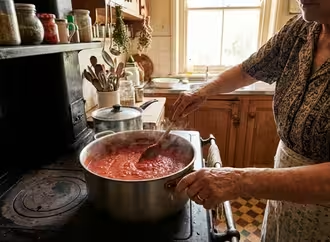
His kitchen was smaller than mine—these Victorian cottages weren't built for serious cooking—but he'd claimed it completely. Dried pasta hanging from a wooden rack. Tomato sauce simmering on the back burner, filling the whole house with garlic and basil. A KitchenAid mixer that looked like it had survived three decades of use.
"My grandmother made pasta every Sunday," Tony said, dumping flour onto his worn wooden cutting board in a pile that seemed excessive. "Taught me when I was eight. Said if I was going to run the family business someday, I needed to know how food was supposed to taste."
He made a well in the center of the flour mountain, cracked four eggs into it with one hand each, and started mixing with his fingers. No measurements. No recipe card. Just muscle memory from thirty-five years of Sunday afternoons.
"Your turn," he said, nodding at my hands.
I've failed at sourdough seventeen times. I burn rice. My mother used to say I could ruin water. But Tony wasn't giving me an option, so I stuck my hands into the egg-and-flour mixture and tried to copy his kneading motion.
"No, no—like this." He guided my hands, showing me how to fold and push, fold and push. "You're not trying to beat it up. You're convincing it to come together. There's a difference."
The dough was sticky and impossible and nothing like the smooth ball Tony's hands were forming. Mine looked like something that belonged in a garbage disposal.
"It takes time," Tony said, not unkindly. "Nonna used to say the dough knows when you're impatient. You gotta slow down."
We worked in silence for a while. Through the window I could see Helen walking back from Bill's porch, empty pie plate in hand. She caught sight of us through Tony's kitchen window and waved. Tony waved back with flour-covered hands, leaving white streaks on the glass.
"Helen makes pies every Sunday too," I said.
"Fourth-generation baker," Tony confirmed. "Her grandmother had a bakery in Parkersburg during the Depression. Helen brought me a peach pie when I moved in—said it was her grandmother's recipe, the one that kept the shop open when nobody had money. People would trade eggs, milk, whatever they had for a slice of pie."
I thought about Helen's grandmother baking during the Depression. Tony's nonna making Sunday pasta in a kitchen probably not much bigger than this one. My own mother, gone six months now, teaching me to fold mandu dumplings at our apartment counter in Seoul before we moved to the States.
My dough was starting to come together—still lumpy, still amateur, but resembling something that might become pasta if I was patient enough.
"Maya's making something too," Tony said, nodding toward her kitchen window across the street. "She told me yesterday she's trying her mom's dumpling recipe. Linda visited last month and showed her how to fold them properly—Maya's been practicing all week."
Maya Chen, thirty-two, usually sticks to gardening and coffee. I'd never heard her mention Chinese cooking. But there she was through her bay window, bent over her kitchen counter with what looked like dumpling wrappers spread out in rows.
"We should invite her over," I said without thinking.
Tony grinned. "Already did. Told her 2:30. She's bringing the dumplings, Helen's bringing pie for after. You're gonna help me roll out this pasta, and we're eating like our grandmothers intended."
At 2:30 exactly, my kitchen was full. Tony had moved the operation to my place because I had a bigger table—an old oak thing that came with the cottage, scarred from a century of use. Maya arrived with a covered bowl of dumplings, still warm. Helen followed with apple pie and a jar of cream she'd gotten from Deb Morrison's farm.
"My grandmother would've loved this," Helen said, settling into a chair while Tony rolled out pasta dough with my rolling pin. "She always said food tastes better when it's made by hands you trust."
"Nonna said the same thing," Tony agreed. "Said that's why restaurant food could never beat Sunday dinner at home. You can taste the love. Sounds corny, but she meant it."
Maya was quiet, watching Tony work the dough into thin sheets. "My mom used to make dumplings every Lunar New Year," she finally said. "I never paid attention—figured I'd learn later. Then I moved out, and later never came."
"So you're learning now," Helen said gently. "That's what matters. I didn't start baking my grandmother's recipes until she was gone. Wish I'd asked more questions when I had the chance."
We cooked together in that small Victorian kitchen, the four of us crowded around a table that had probably seen a hundred years of Sunday dinners. Tony cut pasta into fettuccine, Maya steamed dumplings in my cheap bamboo steamer, Helen sliced pie while the pasta boiled.
The meal was imperfect. My pasta came out slightly thick—beginner's work. Maya's dumplings had uneven folds, some leaking filling. But we ate it all, every bit, sitting at that scarred oak table while winter light came through the tall Victorian windows with their wavy antique glass.
"My grandmother made pasta on this same kind of table," Tony said, twirling fettuccine on his fork. "In a kitchen probably exactly this size. She died in 2003, but every time I make her Sunday sauce, she's right here."
"That's why we keep cooking," Helen said quietly. "That's why the recipes matter. It's not about perfect technique—it's about keeping their hands in ours."
Maya nodded, looking at her own dumpling—lopsided, imperfect, exactly right. "My mom would cry if she could see me finally learning this."
I thought about my own mother, her patient hands guiding mine through dumpling folds I never mastered before she was gone. Thought about all the grandmothers in all the kitchens teaching recipes that mattered more than anyone understood at the time.
We aren't chefs. We're just people in Victorian cottages trying to remember what our grandmothers taught us, or learning what we should've learned earlier, or teaching each other what we know. That's what Sunday afternoons are for.
After we'd eaten everything—pasta, dumplings, pie with farm cream—Tony started teaching me how to clean the pasta-making tools properly. Helen showed Maya a trick for storing leftover dumplings. We moved slow, no rush, the kind of Sunday afternoon that stretches time.
Before they left, Tony pressed a container of Sunday sauce into my hands. "For next time," he said. "You're making pasta again next week. Can't let one lesson be the end."
"And I'm teaching you pie crust," Helen added, pointing at Maya and me. "My grandmother's recipe. Takes practice, but you'll get it."
Maya grinned, the first real smile I'd seen from her in weeks. "And you're both learning dumplings. My mom's coming to visit next month—we'll make a whole day of it."
They left as afternoon faded toward evening, and I stood in my kitchen looking at the flour still dusting the counter, the empty bowls, the sauce Tony left behind. Through the window I could see lights coming on in cottages up and down Front Street—other dinners happening, other traditions being kept or learned or invented.
This is what SILK calls "cafe culture," but that makes it sound commercial, organized. Really it's just what happens when people live close enough to share kitchens and old enough houses to remember that Sunday afternoons were meant for this—grandmothers' recipes, imperfect attempts, flour everywhere, and the quiet understanding that some things matter more than getting them perfect the first time.
Next Sunday I'm making pasta again. Tony said he'd bring the sauce and Helen promised to stop by with fresh-churned butter from Deb's farm. Maya's practicing dumplings all week. We're learning what our grandmothers knew: that food made by trusted hands tastes like home, and home is something you build one Sunday at a time.
8 COMMENTS


Emma Clarke
22 Dec 2024This is beautiful. My grandmother's SCOBY recipe is the same—no measurements, just feel. These old recipes know something we've forgotten.
REPLYBob Harrison
22 Dec 2024Helen's grandmother's bakery saved my family during the Depression. We'd trade eggs from our chickens for bread. Seeing her keep that tradition alive means everything.
REPLYLinda Chen
22 Dec 2024Maya called me crying after reading this. I'm so proud she's learning the dumplings. My mother would be too. Coming to visit next month to teach the whole group!
REPLYMaya Chen
17 Dec 2024This brings back so many memories of our community meals. Food really does bring us together.
REPLYEmma Clarke
17 Dec 2024I still have that SCOBY you gave me! Making kombucha has become my weekly ritual now.
REPLYBill Henderson
18 Dec 2024Good food, good company. That's all you need.
REPLYFrank Morrison
18 Dec 2024As the farmer who grows some of these vegetables, it means everything to see them appreciated like this.
REPLY