



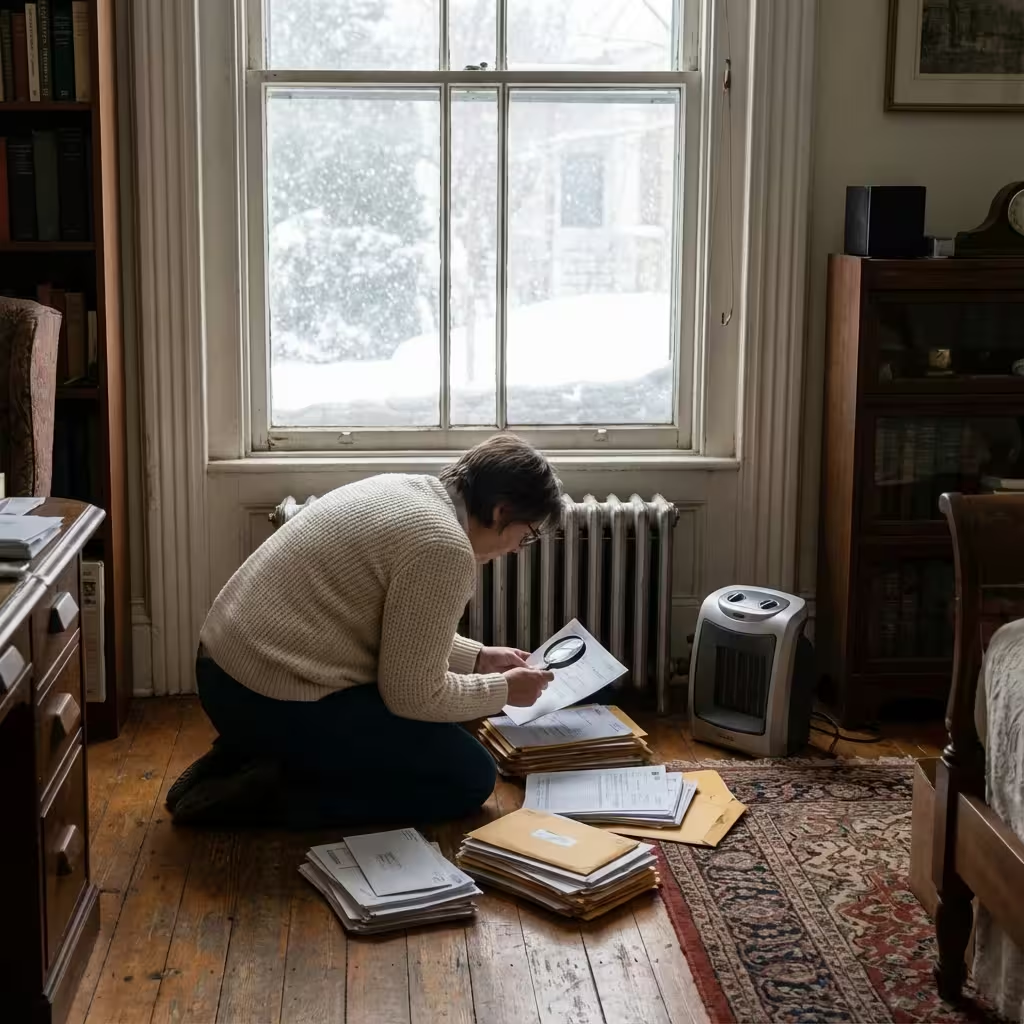
I moved into the SILK cottage on Market Street in September, when the weather was still warm and the house felt charming. Twelve-foot ceilings, original woodwork, windows with wavy glass that made the world outside look dreamlike. I loved it immediately and completely.
Then November arrived, temperatures dropped, and I discovered that Victorian charm comes with Victorian heating systems.
The First Cold Morning
I woke up on a Tuesday in early November to frost on the inside of the bedroom window. Not condensation. Actual frost. The kind you scrape off car windshields. I was wearing two blankets and still cold.
The thermostat read 58 degrees. I'd set it to 68 the night before. The radiators were technically warm, but not hot. They made occasional clanking sounds, like someone tapping pipes with a wrench two floors away.
I turned the thermostat up to 72. Nothing changed. The radiators continued their lukewarm existence and sporadic percussion.
Bill found me in the kitchen that afternoon, wearing a hoodie over a flannel over a t-shirt, making tea just to hold something warm. "Radiators acting up?" he asked, like he'd seen this before.
"They won't get hot. And they make noise."
"You bleed them yet?"
I had no idea what that meant. Bill sighed the sigh of someone about to teach something that should've been taught long ago.
Radiator Basics I Should've Known
The clanking, Bill explained, was air trapped in the system. Hot water heats radiators, but if air gets in, the water can't circulate properly. You fix it by "bleeding" the radiator—letting the trapped air escape through a small valve.
He showed me how. Turn the valve slowly with a radiator key until you hear hissing. That's air escaping. When water starts dripping, close it. Simple. Except I didn't own a radiator key and had never heard of such a thing.
Bill lent me his. I went through the house, bleeding every radiator. Air hissed out—some had a lot, some had barely any. By evening, the radiators were actually hot. The house was approaching comfortable.
Then the December gas bill arrived: $340.
I stared at it for a full minute. That was more than my grocery budget. More than my car payment. For one month of mediocre heat in a two-bedroom cottage.
Heating a Victorian isn't about making it warm. It's about choosing which rooms to keep livable and accepting that the rest will just be cold.
The Great Window Project
I became obsessed with heat loss. Watched videos, read articles, measured the temperature difference between rooms. The problem was obvious: windows. Single-pane, wavy glass from 1892, wooden frames so warped from settling that light showed through the gaps.
I bought weatherstripping. The adhesive kind, supposedly easy. I spent an entire Saturday trying to stick it to frames so uneven that nothing adhered for more than a day. The strips peeled off, curled up, or fell behind radiators where I couldn't reach them.
I bought the plastic shrink-wrap window insulation kit. You tape plastic film over the window, then use a hair dryer to shrink it tight. It works, technically. It also makes your beautiful wavy-glass windows look like they're wrapped in Saran wrap, and every time someone visits they ask if you're painting.
Jesse stopped by to borrow a ladder and found me on my third attempt to get the bedroom window plastic smooth. "You know that's not gonna help much, right?"
"It's supposed to create an air gap. Insulation."
"Sure. But the real problem is those twelve-foot ceilings. All your heat is rising. Plus the walls aren't insulated. The windows are just the obvious leak."
He was right, but fixing walls and ceilings meant construction I couldn't afford and wasn't allowed to do in a rental. The windows were something I could address, even if it didn't address enough.
Sarah's Curtain Intervention
Sarah appeared one evening in December with heavy thermal curtains she'd bought for her old apartment. "These don't fit my windows. They'll fit yours. Hang them."
I hung them. Thick, insulated, blackout curtains that blocked the wavy glass I loved but also blocked the cold radiating off those single panes. The difference was immediate and humbling. Curtains. The solution was curtains.
"Close them at night, open them during the day if it's sunny," Sarah instructed. "And close the doors to rooms you're not using. Heat what you actually live in."
It was practical advice that felt like defeat. I'd wanted to heat the whole house, to make every room warm and welcoming. But Victorian houses weren't built for that. They were built for fireplaces in every room and servants who kept them going. I had neither.
Choosing My Rooms
I started closing off the second bedroom entirely. Shut the door, turned off the radiator, accepted that it would hover around 50 degrees all winter. Same with the dining room—I didn't use it anyway. The bathroom I kept warm enough to shower without suffering.
What I actually heated: the kitchen, the living room, my bedroom. Three rooms in a whole house. The thermostat stayed at 65, lower than I'd wanted but sustainable for my budget. I wore slippers and sweaters and stopped expecting to walk around in a t-shirt.
The January gas bill: $180. Still high, but manageable. And the house felt warmer, weirdly, because the heat was concentrated where I actually spent time.
The 3am Clanking Problem
Bleeding the radiators fixed some of the noise. Not all. The bedroom radiator still clanked violently around 3am when the heat kicked on for the overnight cycle. It was a specific, metallic CLANK that jolted me awake and sounded like someone dropping a wrench inside the wall.
Tom diagnosed it in thirty seconds. "Water hammer. The pipe's loose somewhere. When steam hits it, it jumps and bangs against the bracket."
Fix: shim the radiator so it angles slightly toward the pipe. Gravity helps the water flow back, reduces the hammering. Tom showed me how using a small wooden shim and about two minutes of effort.
The clanking reduced by maybe 70 percent. Not silent, but tolerable. I bought earplugs for the nights when it wasn't.
What February Taught Me
By February, I'd developed routines. Morning: open curtains in the living room and bedroom if the sun was out, leave them closed if it wasn't. Evening: close all curtains before dark. Before bed: turn the thermostat down to 60, add an extra blanket.
I learned which parts of the house were always cold—the north-facing bathroom, the hallway by the front door—and stopped trying to fix them. Put a bath mat down so stepping out of the shower wasn't painful. Hung a coat by the door for the thirty seconds it took to cross the cold hallway to the warm kitchen.
I learned that radiator heat feels different from forced air. It's gentler, more even, less drying. Once I got the system working properly, I actually preferred it. When the radiators were hot, the house felt warm in a soft, old-fashioned way that didn't blast you with furnace air.
The February gas bill: $165. I'd figured out something that worked.
Advertisement
March Thaw and Reflection
March arrived with warmer days and the realization that I'd survived my first Victorian winter. The house hadn't been uniformly warm. I'd spent more on heat than in any apartment I'd rented. I'd learned more about radiators, steam systems, and heat loss than I ever wanted to know.
But I'd also learned to work with the house instead of against it. To accept that 130-year-old buildings have limitations and quirks. That "energy efficiency" in an old house looks different than in a modern one—you're not optimizing performance, you're just reducing waste where you can.
Bill asked how I did, cost-wise. I told him about the journey from $340 to $165. He nodded. "That's about right for this place. Jesse's is similar. Sarah's is lower but she's gone half the time for work."
"Does it get easier? The second winter?"
"You'll know what to expect. Bleed the radiators in October before you need them. Hang the curtains early. Maybe get a small space heater for the bathroom." He smiled. "And yeah. It gets easier."
What I'd Tell Someone Moving In
If someone moved into this cottage next September, I'd tell them:
Learn to bleed radiators before it gets cold. Buy a radiator key in advance. Get heavy curtains—they matter more than weatherstripping. Accept that you'll heat rooms you use, not rooms you don't. The clanking is probably air or water hammer, both fixable. The frost on the windows is normal and you can't stop it, just minimize it.
Your gas bill will be higher than you expect. But it'll stabilize once you figure out the system.
And wear slippers. The heart pine floors are beautiful but they're cold as hell.
14 COMMENTS




Bill Harrison
20 Dec 2024You figured it out faster than most. Jesse took two winters to get his bill under $200.
REPLYSarah Chen
20 Dec 2024Those curtains were the best investment I never got to use. Glad they found a good home.
REPLYTom Richardson
20 Dec 2024Water hammer fix is the simplest thing that nobody knows about. Saved you months of bad sleep with a shim.
REPLY